
Morrow County Court Records After Jail Arrest
Morrow County court records after jail arrest involve three different record streams. The JDS roster linked by the sheriff shows that a person is in the Morrow County Correctional Facility and lists custody fields such as Jail ID, charges, court, current disposition, total bail, book date, attorney, next court date, arresting agency, and release date. That roster is a custody source. It is useful, but it is not the whole court file.
The court record begins when a complaint, information, indictment, or related filing opens a case. The Morrow County Prosecutor's Office prosecutes felony and misdemeanor crime and works with law enforcement agencies in the county. After a jail arrest, that office may file, amend, reduce, dismiss, or present charges to a grand jury. Booking facts stay with the jail side. Filed charges, hearings, pleas, judgments, and sentences are read through the court and clerk side.
For custody and booking detail, the related Morrow County jail inmate records page covers the roster. For booking photos, the Morrow County jail mugshots page explains the roster photo field and records-request path. Court records after an arrest should be checked separately because a court docket can show actions that do not appear on the jail roster.
Find Morrow County Arrest Court Records
Morrow County has more than one court search path. The Morrow County Municipal Court handles criminal, traffic, civil, and small-claims search functions and is the likely first stop for many misdemeanor, traffic, and preliminary felony matters. The Morrow County Clerk of Courts supports Common Pleas Legal Division access, and the clerk links to CourtView eServices for court payments and attorney eFiling. Common Pleas is the general-jurisdiction court for felony and other higher-level matters.
- Start with the JDS roster and note the name, book date, listed court, charge text, current disposition, and total bail.
- If the roster court is Morrow County Muni, search the Municipal Court site or call the court for the current docket route.
- If the roster court is Common Pleas, use the Clerk of Courts and CourtView eServices link, then verify with the Common Pleas Legal Division if the online result is thin.
- Compare each roster charge with the filed court charge, because a booking label can be amended, reduced, dismissed, or replaced.
- For older files or records not shown online, contact the clerk or court that holds the case and ask for the public-record access process.
The Morrow Mayor's Court docket search is a separate tool. During research it showed cases with filing dates on or after July 7, 2021, and result columns for last name, first name, ticket number, date of offense, case number, case type, and court date. That tool may help with municipal-level ticket and local docket matters, but it should not be treated as the master search for all jail arrests.
| Search Field | Type | Required | Notes |
|---|---|---|---|
| Search by Name | radio or tab | No | Enables first-name and last-name fields. |
| Case Number | text | No | Use when the exact case number is known. |
| Case Type | dropdown | No | Options observed include felony, misdemeanor, OVI, other, and traffic categories. |
| Ticket Number | text | No | Useful for citation-based matters. |
| Date of Offense | date | No | Can narrow results when the arrest date or offense date is known. |
| Court Date | date | No | Can narrow a known docket date. |
The Morrow County Common Pleas Court page is also a useful reference for jurisdiction and hours. The court lists Judges Tom C. Elkin and Robert C. Hickson, Jr., and describes Common Pleas as the original court of general jurisdiction with General, Juvenile, Probate, and Domestic Relations divisions.
Morrow County Court Portal Screens
The manifest includes a successful screenshot of the Morrow County CourtView eServices portal, which is the clerk-linked access point for court payments and attorney eFiling.
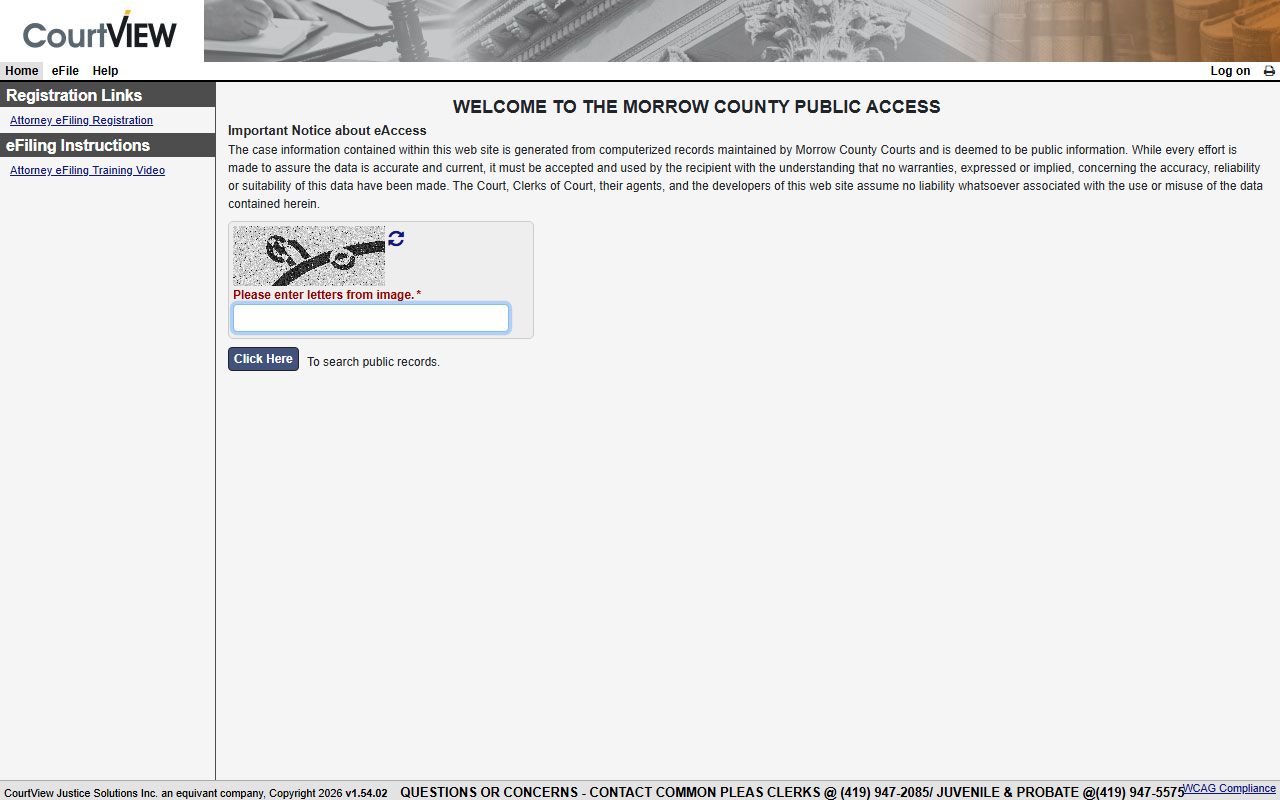
Use that portal as one part of the court-record search path, then verify charge status with the clerk or court when a docket result does not show the full criminal-case history.
Morrow County Charging Documents
Charges after a Morrow County jail arrest may start with a complaint, an information, or an indictment. The exact document depends on the court, the offense level, and how the prosecutor moves the case. A complaint often appears near the start of a criminal proceeding. An information is a formal prosecutor filing in some felony contexts. An indictment is a grand-jury charging document for felony prosecution.
| Document | Who Files It | How It Fits the Case |
|---|---|---|
| Complaint | Law enforcement or prosecutor | Often starts misdemeanor cases or the first stage of criminal proceedings. |
| Information | Prosecutor | Formal charge document used in some felony contexts. |
| Indictment | Grand jury | Grand-jury charge document, commonly tied to felony prosecution. |
These documents matter because the jail roster's charge label may not match the final charge in court. A roster row can show an arrest or hold label. The court record can later show an amended charge, a reduced charge, a dismissal, a plea, or a sentencing entry.
Morrow County Charge Status
Charge status is the live part of court records after an arrest. The JDS roster has a current-disposition field, and observed values included sentenced, unsentenced, dismissed per court, and unsentenced out-of-county warrant. The docket may show more court-specific events, such as arraignment, motion practice, plea, trial setting, sentencing, or dismissal. Read each charge line on its own terms.
| Status | What It Means |
|---|---|
| Pending | The charge remains active and has not reached final disposition. |
| Unsentenced | The roster shows no sentence imposed for that charge or hold. |
| Amended or reduced | The prosecutor or court changed the charge from an earlier label. |
| Dismissed | The charge line ended without a conviction on that charge. |
| Sentenced | The case or charge has reached a sentence stage for that entry. |
| Out-of-county warrant | Another jurisdiction has a warrant or hold tied to the custody entry. |
Charge-status check: A roster disposition is a custody clue. The court docket is the better source for filed charges, pleas, dismissals, and sentencing entries.
Bond After Morrow County Arrest
Bond appears on Morrow County roster entries in the total-bail field. Research found amounts ranging from zero-dollar entries to large bond amounts, but the number alone does not prove a person can be released. A probation violation, bond revocation, out-of-county warrant, 48-hour hold, detainer, or court order can block release even when a dollar amount appears.
Ohio law sets the statewide bail framework. Ohio Constitution Article I, Section 9 addresses bail by sufficient sureties. ORC 2937.011 governs surety responsibility, and ORC 2937.40 covers discharge and release of bail. Local payment steps should be verified with the jail or court because the sheriff page does not publish a full bond-payment schedule.
| Bond Type | How It Works |
|---|---|
| Cash bond | Cash or approved certified funds satisfy the release condition when allowed by the court. |
| Surety bond | A licensed surety or bail agent guarantees the person's appearance. |
| Property bond | Real estate or securities may secure release if the court allows it. |
| Recognizance | The person is released on a promise to appear, often called PR or own recognizance. |
| No-bond hold | A warrant, detainer, probation or parole hold, or court order blocks release. |
For a Municipal Court case, contact Morrow County Municipal Court at 48 E. High St., Room A, Mt. Gilead, or call 419-947-5045. For a Common Pleas matter, use the Clerk of Courts Common Pleas Legal Division at 48 East High Street and the clerk phone numbers listed by county sources.
Morrow County Arrest Warrants
No official Morrow County active-warrant search page was found on the sheriff or county site. The jail roster can still show warrant-related custody after arrest. Research found roster language such as failure to appear, out-of-county warrant, and unsentenced out-of-county warrant. That means the roster can confirm a person already booked on a warrant or hold, but it is not a full pre-arrest warrant database.
For warrant questions, use official channels. Dispatch can route nonemergency questions at 419-946-4444, and sheriff records or administration can be reached at 419-947-4845. Courts can show failure-to-appear events, bench warrants, and active case status. A person trying to clear a warrant should contact the issuing court or an attorney and verify the case number, bond status, and hold status before relying on a third-party listing.
- Arrest warrant
- A court order authorizing arrest based on a criminal charge.
- Bench warrant
- A judge-issued warrant, often for failure to appear or violation of a court order.
- Detainer
- A hold from another agency that may keep a person in jail after local bond is addressed.
Charges vs Convictions
A Morrow County arrest and charge are not the same as a conviction. A charge is an accusation or filed allegation. A conviction requires a guilty plea, finding of guilt, or verdict. Court records after jail arrest should be read with that difference in mind, especially when a roster charge later shows dismissed per court or the court docket shows a reduced count.
| Point | Charge | Conviction |
|---|---|---|
| Meaning | An alleged offense after arrest or filing. | A final guilty plea, finding, or verdict. |
| Stage | Early or pending case stage. | Final or near-final case stage. |
| Can Change | May be amended, reduced, or dismissed. | Changes only through later court action, appeal, sealing, or expungement rules. |
| Where to Verify | Roster plus court docket. | Court judgment, sentencing entry, or clerk record. |
Sealed vs Expunged Records
Ohio sealing and expungement rules matter when a Morrow County court record follows an arrest that later ends in dismissal, not guilty finding, grand-jury no bill, pardon, eligible conviction, or eligible bail-forfeiture outcome. ORC 2953.32 addresses applications to seal or expunge conviction records and bail-forfeiture records. ORC 2953.33 covers sealing official records after not guilty findings, dismissals, no bills, and pardons.
| Point | Sealed | Expunged |
|---|---|---|
| Public visibility | Hidden from most public access after a court order. | Destroyed, deleted, or treated as removed where the statute allows. |
| How it happens | By application and court order under Ohio law. | By application and court order when expungement is legally available. |
| Local effect | Do not assume a roster or docket changed until the court order is processed by the right office. | Do not assume private copies vanish without the legal process and proper notice. |
Important: This privately operated resource is not a consumer reporting agency and cannot be used for employment, housing, credit, insurance, or any FCRA-covered decision.
Restricted Court and Arrest Records
Ohio public-record access is broad, but not every record tied to a jail arrest is public. ORC 149.43 governs inspection and copying by public offices, subject to exemptions and redactions. The sheriff records policy says reports are not released until completed and approved, investigator notes are not public record, reports still under investigation will not be released, and Social Security numbers are redacted.
Juvenile records have additional limits. Sealed charges, expunged records, active-investigation material, protected personal data, and certain victim or witness information may be withheld or redacted. The practical rule is simple: use the roster for current custody, use the correct court for filed charges, and verify any missing or restricted court record with the office that created it.